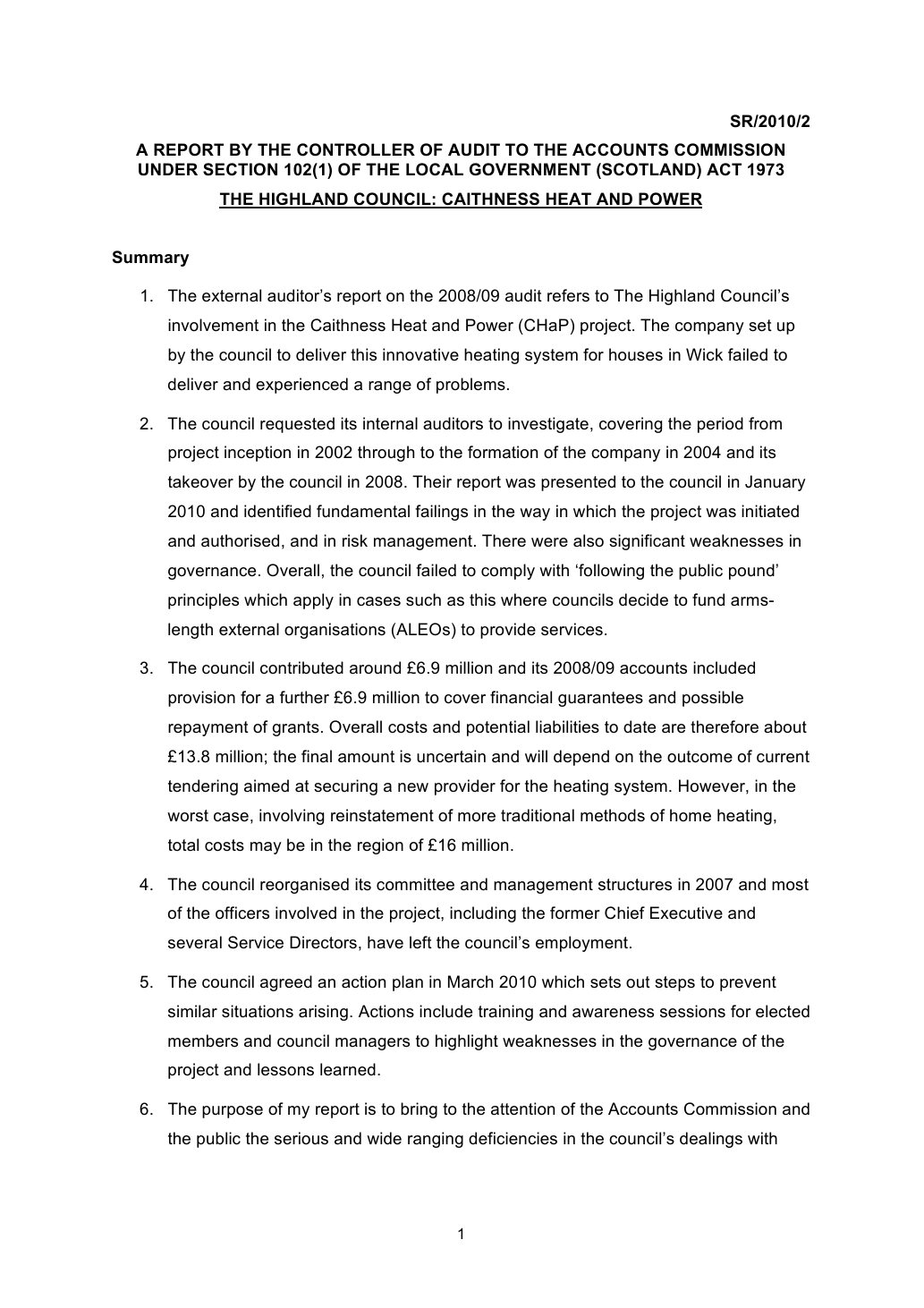
Accessible version
Plain-text transcript preview
Generated by layout-aware native PDF text extraction. Tables, maps, columns, and symbols may not translate perfectly.
[Page 1]
SR/2010/2
A REPORT BY THE CONTROLLER OF AUDIT TO THE ACCOUNTS COMMISSION
UNDE R SECTION 102(1) OF THE LOCAL GOVERNMENT (SCOTLAND) ACT 1973
THE HIGHLAND COUNCIL: CAITHNESS HEAT AND POWER
Summary
1. The external auditor’s report on the 2008/09 audit refers to The Highland Council’s
involvement in the Caithness Heat and Power (CHaP) project. The company set up
by the council to deliver this innovative heating system for houses in Wick failed to
deliver and experienced a range of problems .
2. The council requested its internal auditors to investigate, covering the period from
project inception in 2002 through to the formation of the company in 2004 and its
takeover by the council in 2008. Their report was presented to the council in January
2010 and identified fundamental failings in the way in which the project was initiated
and authorised, and in risk management. There were also significant weaknesses in
governance . Overall, the council failed to comply with ‘following the public pound’
principles which apply in cases such as this where councils decide to fund arms -
length external organisations (ALEOs) to provide services.
3. The council contributed around £6.9 million and its 2008/09 accounts included
provision for a fur ther £6.9 million to cover financial guarantees and possible
repayment of grants. Overall costs and potential liabilities to date are therefore about
£13.8 million; the final amount is uncertain and will depend on the outcome of current
tendering aimed at securing a new provider for the heating system. However , in the
worst case, involving reinstatement of more traditional methods of home heating ,
total costs may be in the region of £16 million.
4. The counc il reorganised its committee and management s tructures in 2007 and most
of the officers involved in the project, including the former Chief Executive and
several Service Directors, have left the council’s employment.
5. The council agreed an action plan in March 2010 which sets out steps to prevent
similar situations arising. A ctions include training and awareness sessions for elected
members and council managers to highlight weaknesses in the governance of the
project and lessons learned.
6. The purpose of my report is to bring to the attention of the Accounts Commission and
the public the serious and wide ranging deficiencies in the council’s dealings with
1
[Page 2]
Caithness Heat and Power and to highlight matters for councils to consider in future
when approving and governing projects of this nature.
Introduction and background
7. In 2002, the council initiated a project aimed at providing heat and hot water to 500
homes in Wick from an innovative wood-fired system. In later phases, it was
envisaged that the system would provide heat and hot water to a wider community
and would also generate income from the sale of electricity to the national grid.
Assurances were provided to the council that each phase of the project would be
self-contained and fully funded.
8. Between 2002 and 2004, officers based locally made a series of reports on the
project to the Caithness Area Committee. During that time, an officer and two local
elected members visited Finland and the Shetland Islands to help establish the
scope of the project. The Area Committee approved the project in principle in March
2004.
9. This decision was ratified by the council in October 2004, at which point it a greed to
establish Caithness Heat and Power Limited as a community -owned enterprise to
deliver the project. However, due to significant financial and technical difficulties , the
council decided in August 2008 to take ownership of the company. The council’s aim
at that point was to: improve governance and financial stewardship; maintain he at
and hot water to the 247 houses connected to the system by way of a temporary oil -
fired boiler; and seek a longer term solution. A high-level summary of key events
from project inception through to takeover by the council is set out in Appendix 1.
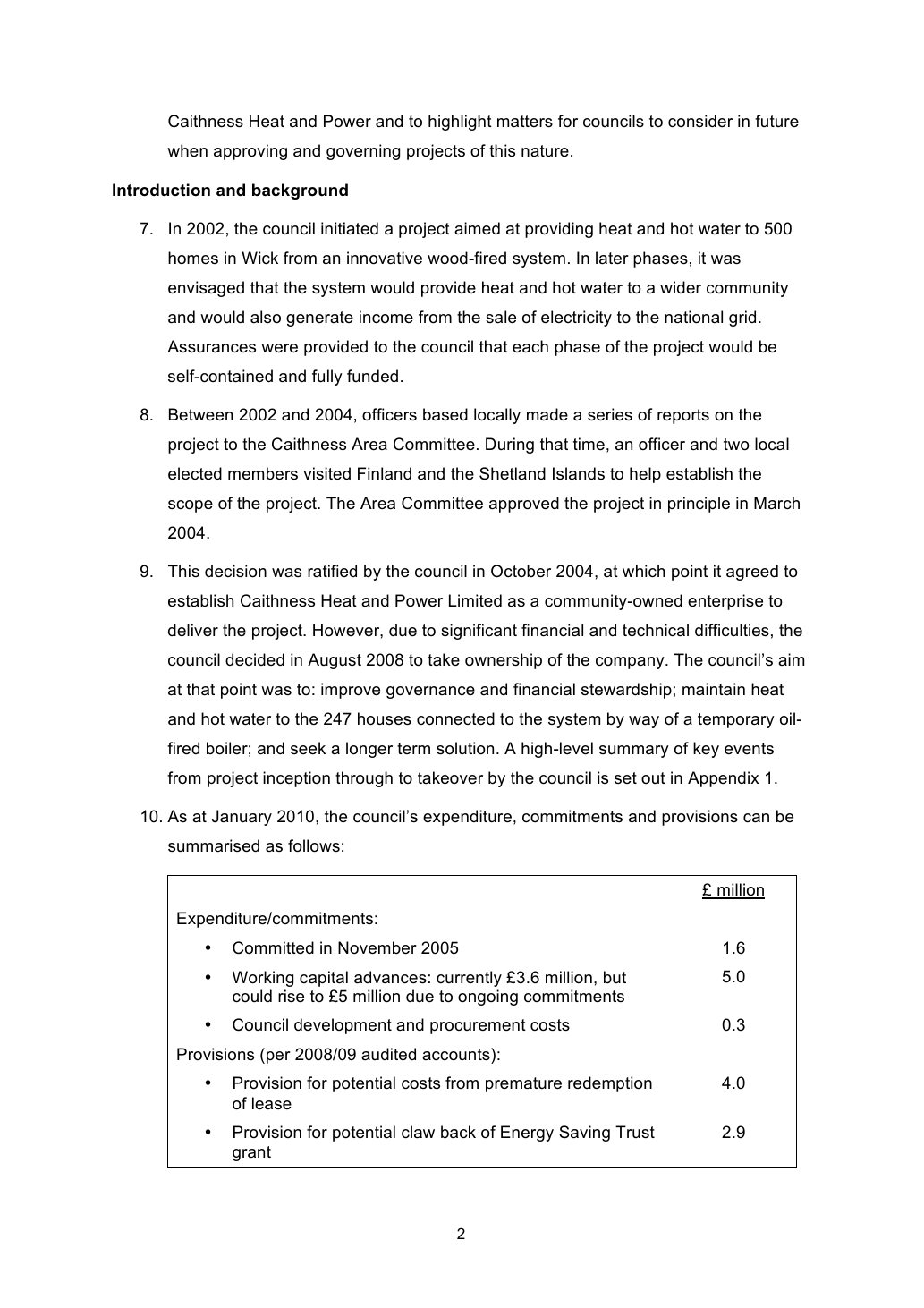
10. As at January 2010, the council’s expenditure, commitments and provisions can be
summarised as follows:
£ million
Expenditure/commitments:
• Committed in November 2005 1.6
• Working capital advances: currently £3.6 million, but 5.0
could rise t o £5 million due to ongoing commitments
• Council development and procurement costs 0.3
Provisions (per 2008/09 audited accounts) :
• Provision for potential costs from premature redemption 4.0
of lease
• Provision for potential claw back of Energy Saving Trust 2.9
grant
2
[Page 3]
___
Overall actual and potential cost s 13.8
11. Potential future costs are uncertain until decisions on next steps are taken, and will
depend on whether the council can secure a new provider for the heating system.
Following a tendering exercise the council is currently negotiating with two
companies that have expressed an interest in taking over the project. If these
negotiations are not successful the council estimates that in the worst case, involv ing
reinstatement of conventional heating systems in the properties, the total costs over
the lifetime of the project could be of the order of £16 million.
12. The council’s internal auditors reviewed the governance of the project from its
inception through to the time at which the council took control of the company. The
external auditors have reviewed internal audit’s work and have informed me that in
their opinion the scope of the internal audit investigation , the audit approach and the
conclusions are appropriate. They have also informe d me that in their opinion the
council’s action plan reflects the key improvements required . I relied on the se audit
findings to highlight key issues in this report and provided a copy of the report to the
council’s Chief Executive for comment.
There were f undamental failings in project initiation and authorisation, and in project
risk management
13. The internal auditors’ investigation identified a range of issues arising from project
initiation and approval. In particular , they found :
• Given its size and nature, it was inappropriate for the Area Committee to
consider the project and to approve it in principle. Eight reports were
considered between August 2002 and August 2004 . Despite the potential costs
and the risks associated with the use of new technology, these reports were
made without recourse to a Headquarters Committee (specifically the
Resources Committee within whose remit matters of this nature f ell, in terms of
the council’s Scheme of Delegation ).
• In relation to the locally based officer who initiated the project , internal audit
questioned whether the officer had the appropriate qualifications and skills to
take forward a project of this nature .
• Although the elected member and officer visits to Finland and the Shetland
Islands to inspect district heating systems were intended to inform decision
3
[Page 4]
making, it is not evident that the visits were of relevance. Furthermore, internal
audit questioned whether the elected members and officer in attendance
possessed the appropriate skills and qualifications.
• In terms of the council’s Scheme of Delegation it was inappropriate for the
project to have been initiated and progressed by the Planning & Development
Service when the remi t lay with Property & Architectural Services, wh ich had
the technical expertise and authority to investigate and recommend projects of
this nature. There is evidence that the most senior officer in Property &
Architectural Services expressed concerns about the project to senior officer
colleagues outwith his department in advance of the council’s approval, but it
appears no effective action was taken .
• The momentum and expectation of delivery at area level led to the application
for external grant funding from the Energy Saving Trust. This was submitted by
locally based officers without recourse to council headquarters and contained
inaccuracies. The announcement in September 2004 of grant funding of £1.54
million and the p erceived benefits for the Caithness area was made prior to the
council’s approval of the project in October 2004.
• The council approved the project without establishing whether it had been
subject to a formal project and risk appraisal or if a sound business case
existed.
• The council approved the establishment of C HaP Limited without receiving
proper assurances regarding the project and without key documentation being
in place. In particular, there was no formal project appraisal , business plan or
risk management plan, nor was there any detail of the proposed remit,
structure, resourcing and governance of the company .
14. In relation to risk management, the internal auditors concluded that inadequate
consideration was given to the vari ous risks (technical, financial, business and legal)
associated with the project, both at the outset and during the project’s life. When
risks were identified these were largely dismissed and were not formally recorded
and managed. In addition, the measure s to mitigate any risks were insufficiently
considered, were inappropriate or were disregarded. Internal audit concluded that
there was a drive to push ahead by certain officers irrespective of the risks identified.
4
[Page 5]
There were also signi ficant weaknesses in governance
15. The internal audit ors identified significant weaknesses in the governance of the
project. In particular, they found:
• It was not evident to internal audit that the council’s elected member on the
CHaP Board had the appropriate skil ls or had received appropriate training to
fulfil the role effectively.
• The council acknowledged the need to strengthen the governance
arrangements, before the project commenced and throughout its life, but no
meaningful progress was made. Governance was exercised on an ad- hoc
basis and with no clarity as to how and by whom any resultant actions would be
addressed.
• Despite initial assur ances from a locally based officer to the Area Committee
that the company would employ professional managers, th is did not happen to
the extent envisaged and the council provided a considerable resource and
effectively took on the role of professional managers.
• Governance of the project was weakened by a lack of communication between
Area and Headquarters staff. In particular, and at critical times before the
project was agreed by the council and over the duration of the project ,
Headquarters was not made aware of important issues and developments.
• Despite the risks inherent in an innovative project, following the project’s
approval in October 2004 reporting to the council was infrequent and only took
place when the company was urgently seeking funds. Reports also provided
assurance that the project was on track when this was not the case. When key
decisions were made by the company, in particular to move beyond the initial
phase to include electricity generation and to merge the distinct phases of the
project , despite the ir significance these were not brought to the attention of the
council.
• Prior to the council approving the project, council officers worked with the
proposed company’s prospective external legal and technical advisors ,
effectively engaging them prior to the company’s incorporation. As a
consequence, the council’s Contract Standing Orders were breached .
• Although a form of due diligence was undertaken by the company before it
awarded the gasification tender (which extended the project to include
electricity generation) in April 2006, the risks hi ghlighted were not adequately
5
[Page 6]
considered by the officers involved in the project locally, or the council-
nominated Member on the CHaP Board. Furthermore, these risks were not
made known to the council when it would have been appropriate to do so given
their significance. Ultimately the project failed because the company procured
‘experimental’ and high risk gasification technology which could not be
commissioned successfully. In awarding the contract , the CHaP Board decided
to procure a system which had no clear history of success elsewhere.
• Although the evaluation of the gasification tenders by the company was
overseen by its external technical advisor, of considerable concern is that the
advertised evaluation criteria, including the need to demonstrate proven
capability, were disregarded. Instead, price and potential output became the
key drivers. The company’s failure to adhere to its advertised criteria
represents a breach of the procurement legislation which could have exposed it
to legal challenge.
16. Internal audit w as of the opinion that the Joint Ventures Board of senior officers was
an appropriate forum for governing the project. Although the board considered the
project in its early stages, until June 2005, the project was not on the agenda for
subsequent meetings. Internal audit has not been able to establish why that was the
case.
17. In relation to the statutory officers, who have specific powers and responsibilities as
set out in the local government legislation, internal audit suggested that the council’s
officers should have exercised greater influence, to varying degrees, on the
governance of the project through the application of their statutory roles .
The counc il did not comply with ‘f ollowing the public pound’ principles
18. Councils fund arms -length external organisations (ALEOs) as alternative way s of
providing vital services and securing social benefits. To ensure that public money is
used properly and achieves value for money, it must be possible to ‘ follow the public
pound’ across organisational boundaries and to establish and maintain good
governance and clear accountabilities for finance and performance. The Accounts
Commission/COSLA Code 1 sets out the principles of best practice when councils
establish s ignificant funding arrangements with ALEOs, covering crucial areas such
as financial and performance monitoring, representation on the boards of ALEOs and
establishing limits on the degree of involvement.
1 The Code of Guidance on Funding External Bodies and Following the Public Pound, Accounts
Commission/Convention of Scottish Local Authorities 1996
6
[Page 7]
19. Internal audit ’s findings on CHaP point to a range of areas where the council did not
comply with the Code’s requirements. As a consequence , officers were not clearly
aware of their responsibilities and relevant monitoring procedures. Where specific
responsibilities were assigned, including maint aining a watching brief to represent
the council’s interests, there is little evidence to suggest these roles were delivered
effectively.
20. The internal audit report highlighted the potential for conflict of interest arising from a
lack of appropriate separation between the responsibilities of council officers and the
advisors to the company. For example, a locally based council officer became
involved in the financial affairs of the company and was appointed Company
Treasurer.
Action taken by the council
21. The current Chief Executive and Depute Chief Executive & Director of Finance
reported to the council on five occasions between May 2008 and February 2009,
informing it about technical, financial and governance problems in the company and
the findings of an operational team of officers set up to support the project. I n
February 2009, they provided an update on the action taken since the council took
over the company in August 2008 to improve governance and financial stewardship,
maintain heat and hot water to tenants and to seek a long term solution. The report
also stated that internal audit would undertake an audit of the project.
22. The council considered the internal audit report at a special meeting in J anuary 2010
and agreed to the actions set out in the report including compulsory training for all
elected members appointed by the council to act as company director . The council
also agreed to inform the external auditors and the Scottish Government of
developments.
23. In March 2010, the council approved an action p lan detailing a range of actions
aimed at preventing similar situations arising along with target dates and the officers
responsible. Steps include: training and awareness sessions for elected members
and council managers to highlight weaknesses in governance of the CHaP project
and to share the lessons learned; and exploring the possibility of legal action against
individuals and others connected with the company. T here is also an action for an
independent review of the possibility of a disciplinary investigation to consider
whether those officers still employed by the council failed to perform their duties in a
professional and competent manner. All actions are to be addressed by 30
7
[Page 8]
September 2010 and this timetable will allow the external auditors to assess and
comment on progress in their report on the 2009/10 audit in October 2010.
Overall conclusions
24. The purpose of my report is to bring to the attention of the Accounts Commission and
the public the serious and wide ranging deficiencies in the Council’s dealings with
Caithness Heat and Power . The internal and external audit reports point to serious
weaknesses in governance and accountability and, in partic ular, failure to comply
with the ‘following the public pound’ principles.
25. I note that t he council has responded to the serious concerns in the internal audit
report and that officers have implemented and continue to implement remedial action
for which they are accountable to elected members. I am informed that most officers
involved in the project have left the council and I am content to allow those thought to
be responsible and still employed by the council to be held to account th rough any
investigatory and disciplinary process which it considers appropriate .
26. The external auditors will assess the progress made and the effectiveness of revised
arrangements as part of their planned audit work and will report in the usual way. I
will monitor the position and may report again in due course.
CAROLINE GARDNER
CONTROLLER OF AUDIT
7 June 2010
8
[Page 9]
APPENDIX 1
THE HIGHLAND COUNCIL: CAITHNESS HEAT AND POWER
SUMMARY OF KEY EVENTS
August 2002 Locally based council officers report to Caithness Area
Committee proposing Community Energy Initiative
2002 – 2004 Project development, including site visits to help establish theThis is the opening portion of a long document. Use Download complete plain text above for the full extracted transcript.