Accessible version
Plain-text transcript preview
Generated by layout-aware native PDF text extraction. Tables, maps, columns, and symbols may not translate perfectly.
[Page 1]

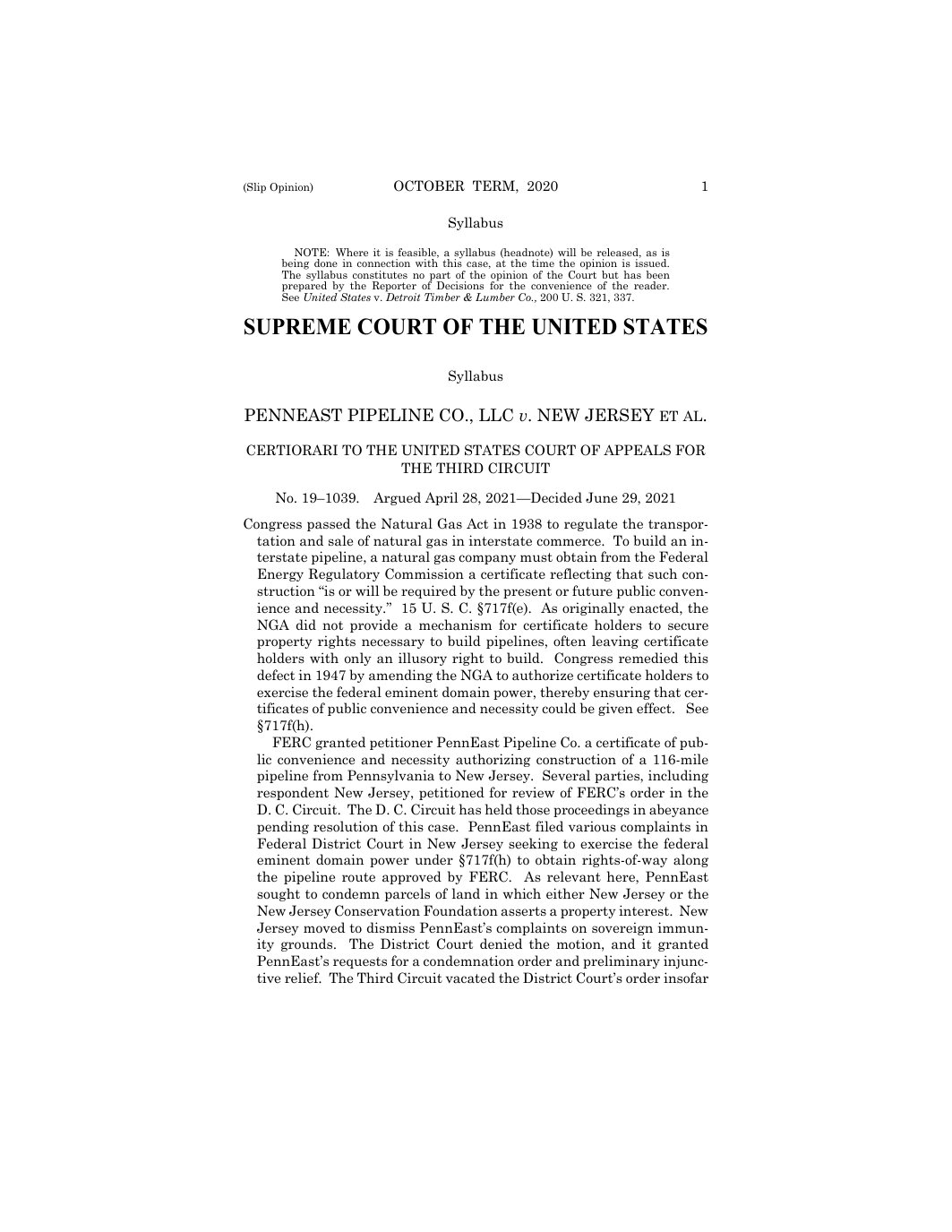
(Slip Opinion)                                                                                          OCTOBER TERM, 2020 1

                                           Syllabus

        being done in connection with this case, at the time the opinion is issued. NOTE:   Where it is feasible, a syllabus (headnote) will be released, as is

        The syllabus constitutes no part of the opinion of the Court but has been
        prepared by the Reporter of Decisions for the convenience of the reader.
        See United States                    v. Detroit Timber & Lumber Co., 200 U. S. 321, 337.
SUPREME COURT OF THE UNITED STATES

                                           Syllabus

PENNEAST PIPELINE CO., LLC v. NEW JERSEY                     ET  AL.

CERTIORARI TO THE UNITED STATES COURT OF APPEALS FOR
                                 THE THIRD CIRCUIT

      No. 19–1039.                        Argued April 28, 2021—Decided June 29, 2021
Congress passed the Natural Gas Act in 1938 to regulate the transpor-
  tation and sale of natural gas in interstate commerce.  To build an in-
  terstate pipeline, a natural gas company must obtain from the Federal
  Energy Regulatory Commission a certificate reflecting that such con-
  struction “is or will be required by the present or future public conven-
  ience and necessity.”  15 U. S. C. §    717f(e).  As originally enacted, the
  NGA did not provide a mechanism for certificate holders to secure
  property rights necessary to build pipelines, often leaving certificate
  holders with only an illusory right to build.  Congress remedied this
  defect in 1947 by amending the NGA to authorize certificate holders to
  exercise the federal eminent domain power, thereby ensuring that cer-
  tificates of public convenience and necessity could be given effect.          See
  §717f(h).
      FERC granted petitioner PennEast Pipeline Co. a certificate of pub-
  lic convenience and necessity authorizing construction of a 116-mile
  pipeline from Pennsylvania to New Jersey.  Several parties, including
  respondent New Jersey, petitioned for review of F                                                                                                                                               ERC’s order in the
  D. C. Circuit.         The D. C. Circuit has held those proceedings in abeyance
  pending resolution of this case.  PennEast filed various complaints in
  Federal District Court in New Jersey seeking to exercise the federal
  eminent domain power under §717f(h) to obtain rights-of-way along
  the pipeline route approved by FERC.  As relevant here, PennEast
  sought to condemn parcels of land in which either New Jersey or the
  New Jersey Conservation Foundation asserts a property interest.          New
  Jersey moved to dismiss PennEast’s complaints on sovereign immun-
  ity grounds.  The District Court denied the motion, and it granted
  PennEast’s requests for a condemnation order and preliminary injunc-
  tive relief.  The Third Circuit vacated the District Court’s order insofar

[Page 2]

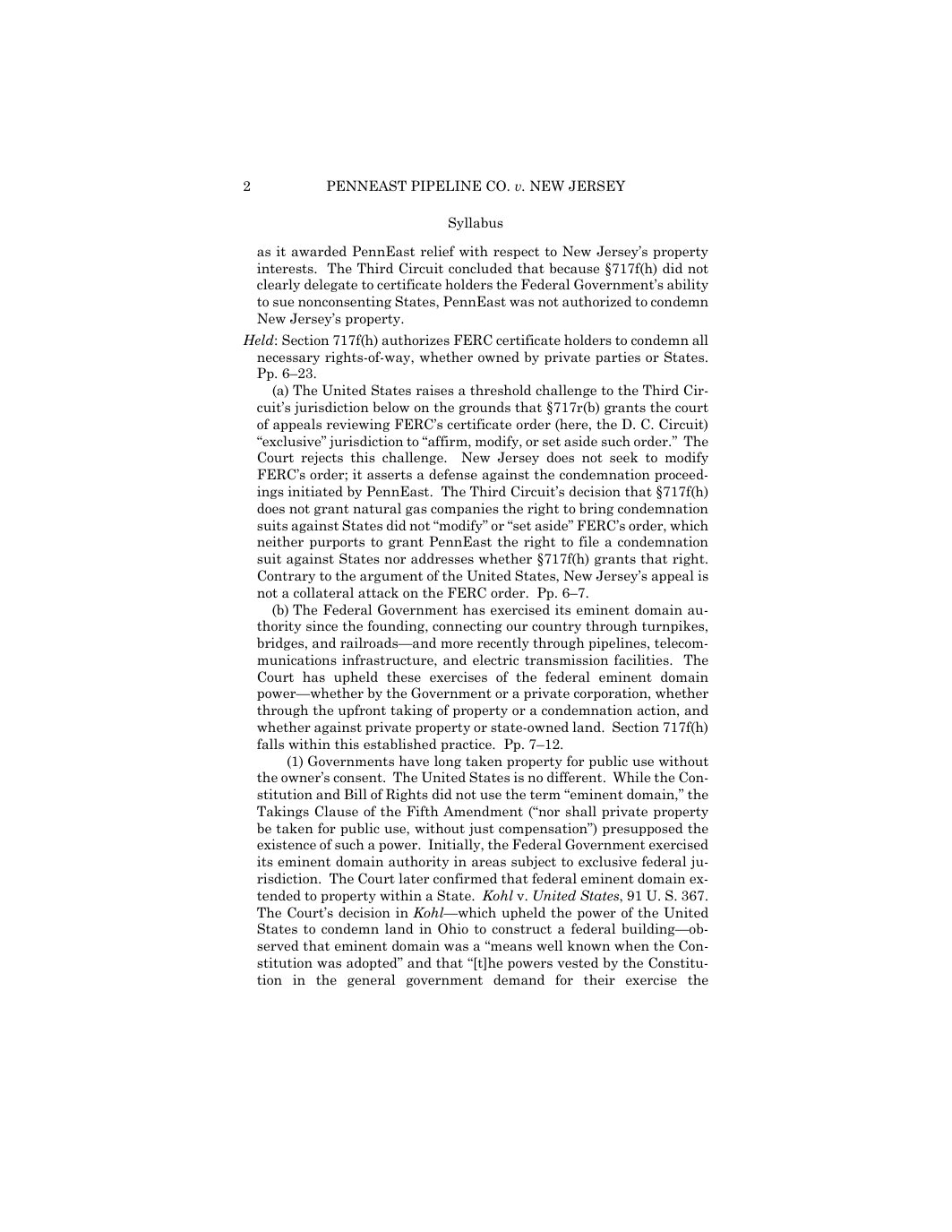
2                                                                                                                                                                     PENNEAST PIPELINE CO. v. NEW JERSEY

                                         Syllabus

  as it awarded PennEast relief with respect to New Jersey’s property
  interests.          The Third Circuit concluded that because §717f(h) did not
  clearly delegate to certificate holders the Federal Government’s ability
  to sue nonconsenting States, PennEast was not authorized to condemn
  New Jersey’s property.
Held: Section 717f(h) authorizes FERC certificate holders to condemn all
  necessary rights-of-way, whether owned by private parties or States.
  Pp. 6–23.
     (a) The United States raises a threshold challenge to the Third Cir-
  cuit’s jurisdiction below on the grounds that §717r(b) grants the court
  of appeals reviewing FERC’s certificate order (here, the D. C. Circuit)
  “exclusive” jurisdiction to “affirm, modify, or set aside such order.”  The
  Court rejects this challenge.  New Jersey does not seek to modify
  FERC’s order; it asserts a defense against the condemnation proceed-
  ings initiated by PennEast.  The Third Circuit’s decision that §717f(h)
  does not grant natural gas companies the right to bring condemnation
  suits against States did not “modify” or “set aside” FERC’s order, which
  neither purports to grant PennEast the right to file a condemnation
  suit against States nor addresses whether §717f(h) grants that right.
  Contrary to the argument of the United States, New Jersey’s appeal is
  not a collateral attack on the FERC order.         Pp. 6–7.
     (b) The Federal Government has exercised its eminent domain au-
  thority since the founding, connecting our country through turnpikes,
  bridges, and railroads—and more re               cently through pipelines, telecom-
  munications infrastructure, and electric transmission facilities.  The
  Court has upheld these exercises of the federal eminent domain
  power—whether by the Government or a private corporation, whether
  through the upfront taking of property or a condemnation action, and
  whether against private property or state-owned land.  Section 717f(h)
  falls within this established practice.  Pp. 7–12.
        (1) Governments have long taken property for public use without
  the owner’s consent.  The United States is no different.  While the Con-
  stitution and Bill of Rights did not use the term “eminent domain,” the
  Takings Clause of the Fifth Amendment (“nor shall private property
  be taken for public use, without just compensation”) presupposed the
  existence of such a power.  Initially, the Federal Government exercised
  its eminent domain authority in areas subject to exclusive federal ju-
  risdiction.  The Court later confirmed that federal eminent domain ex-
  tended to property within a State.  Kohl v. United States, 91 U. S. 367.
  The Court’s decision in Kohl—which upheld the power of the United
  States to condemn land in Ohio to construct a federal building—ob-
  served that eminent domain was a “means well known when the Con-
  stitution was adopted” and that “[t]he powers vested by the Constitu-
  tion in the general government demand for their exercise the

[Page 3]

Cite as:          594 U. S. ____ (2021)                             3

                                        Syllabus

acquisition of lands in all the States.”  Id., at 371–372.  Kohl involved
the condemnation of private land, but the Court subsequently made
clear that “[t]he fact that land is owned by a state is no barrier to its
condemnation by the United States.”  Oklahoma ex rel. Phillips                                                                                                                                                  v. Guy
F. Atkinson Co.                              , 313 U. S. 508, 534.          Pp. 7–9.
      (2) For as long as the eminent domain power has been exercised
by the United States, it has also been delegated to private parties.  The
Colonies, the States, and the Federal Government have commonly au-
thorized the private condemnation of land for public works.  And in the
years following Kohl, the Court confirmed that private delegatees, like
the United States, can exercise the federal eminent domain power
within the States.         In Luxton v. North River Bridge Co                                             ., 153 U. S. 525,
for example, the Court rejected a landowner’s claim that Congress
could not delegate its authority to condemn property necessary to con-
struct a bridge between New York and New Jersey.  Congress had the
sovereign power to construct bridges for interstate commerce, and the
Court confirmed Congress could choose to do so through a corporation.
Id., at 530.          These powers, the Court noted, could be exercised “with or
without a concurrent act of the State in which the lands lie.”  Ibid.
Early cases also reflected the understanding that state property was
not immune from the exercise of delegated federal eminent domain
power.          See Stockton v. Baltimore & N. Y. R. Co., 32 F. 9 (Bradley, Cir.
J.).         The contrary position—that a                 federal delegatee could not condemn
a State’s land without the State’s consent—would give rise to the “di-
lemma of requiring the consent of the state” in virtually every infra-
structure project authorized by the Federal Government.            Id., at 17.
The Court in Cherokee Nation v.                           Southern Kansas R. Co., 135 U. S.
641, echoed Stockton’s explanation of the superior eminent domain
power of the Federal Government when it rejected a challenge to a pri-
vate railroad company’s exercise of the federal eminent domain power
against land owned by the Cherokees.  In reaching that result, the
Court acknowledged that “the national government, in the execution
of its rightful authority, could exercise the power of eminent domain in
the several States,” and the Court labeled as “strange” the notion that
the Federal Government “could not exercise the same power in a Ter-
ritory occupied by an Indian nation or tribe.”  135 U. S., at 656–657.
Pp. 9–11.
      (3) Section 717f(h) delegates to certificate holders the power to
condemn any necessary rights-of-way, including land in which a State
holds an interest.         This delegation of the federal eminent domain au-
thority is consistent with the Nation’s history and this Court’s prece-
dents.         FERC’s issuance to a company of a certificate of public conven-
ience and necessity to build a pipeline carries with it the power—if the
company cannot acquire the necessary rights-of-way by contract at an

[Page 4]

4                                                                                                                                                                     PENNEAST PIPELINE CO. v. NEW JERSEY

                                         Syllabus

  agreed compensation—to “acquire the           same by the exercise of the right
  of eminent domain.”  §717f(h).  This delegation is categorical; by its
  terms, §717f(h) delegates to certificate holders the power to condemn
  any necessary rights-of-way, including land in which a State holds an
  interest.  Pp. 11–12.
     (c) Respondents contend that sovereign immunity bars condemna-
  tion actions against a nonconsenting State.  Alternatively, respondents
  contend that §717f(h) does not speak with sufficient clarity to author-
  ize such actions.         The Court rejects each argument, for reasons stated
  below.          Pp. 13–22.
        (1)   “States’ immunity from suit is a fundamental aspect of the sov-
  ereignty which the States enjoyed before the ratification of the Consti-
  tution.”    Alden v. Maine, 527 U. S. 706, 713.  A State may be sued only
  in limited circumstances, including where the State expressly consents
  or where Congress clearly abrogates the State’s immunity under the
  Fourteenth Amendment.  A State may also be sued if it has implicitly
  agreed to suit in the “plan of the Convention,” which is shorthand for
  “the structure of the original Constitution itself.”  Id., at 728.  The
  Court has looked to the plan of the Convention to permit actions
  against nonconsenting States in the context of bankruptcy proceed-
  ings, suits by other States, and suits by the Federal Government.                  Pp.
  13–14.
        (2)   Respondents do not dispute that the NGA empowers certificate
  holders to condemn private property, but they contend that the same
  certificate holders have no power to condemn state-owned property un-
  der §717f(h).  It is argued that the NGA cannot authorize such con-
  demnation actions under the Court’s decision in Seminole Tribe of Fla.
  v. Florida, 517 U. S. 44, which generally prohibits Congress from using
  its Article I powers to abrogate state sovereign immunity.  But con-
  gressional abrogation is not the only means of subjecting States to suit.
  The States implicitly consented to private condemnation suits when
  they ratified the Constitution, and respondents’ arguments to the con-
  trary cannot be squared with the Court’s precedents.
     Respondents do not dispute that the Federal Government enjoys a
  power of eminent domain superior to that of the States, or that the
  Federal Government can delegate that power to private parties.  Re-
  spondents instead point to the absence of founding-era evidence of pri-
  vate condemnation suits against nonconsenting States to maintain
  that States did not consent to such suits when they entered the federal
  system.  Respondents would divorce the federal eminent domain power
  from the power to bring condemnation actions—and th           en argue that
  the latter cannot be delegated to private parties with respect to state-
  owned lands.  But the eminent domain power is inextricably inter-

[Page 5]

Cite as:          594 U. S. ____ (2021)                        5

                                        Syllabus

  twined with condemnation authority.  Separating the two would di-
  minish the eminent domain power of the federal sovereign, which the
  State may not do.         See Kohl, 91 U. S., at 374.  Absent the power to
  condemn States’ property interests, the only constitutionally permis-
  sible way of exercising the federal eminent domain power would be to
  take property up front and require States to sue for compensation
  later.  State sovereign immunity would not be served by favoring pri-
  vate or Government-supported invasions of state-owned lands over ju-
  dicial proceedings.
     The Court held in United States                                              v. Texas, 143 U. S. 621, that it “does
  no violence to the inherent nature of sovereignty” for a State to be sued
  by “the government established for the common and equal benefit of
  the people of all the States.”     Id., at 646.         In so holding, the Court did
  not insist upon examples from the founding era of federal suits against
  States.  Similar structural considerations support the conclusion that
  States consented to the federal eminent domain power, whether that
  power is exercised by the Government or its delegatees.  The absence
  of a perfect historical analogue to the proceedings PennEast initiated
  below does not suggest otherwise.  Pp. 14–21.
        (3) Finally, respondents argue that even if States agreed in the
  plan of the Convention to condemnation suits by Federal Government
  delegatees, the NGA does not authorize such suits with the clarity re-
  quired by the Court’s precedents.  There is no requirement, however,
  that the Federal Government speak with “unmistakable clarity” when
  authorizing a private party to exercise its eminent domain power.         Pp.
  21–22.
938 F. 3d 96, reversed and remanded.

  ROBERTS, C. J., delivered the opinion of the Court, in which BREYER,
ALITO, SOTOMAYOR, and KAVANAUGH, JJ., joined.         GORSUCH, J., filed a
dissenting opinion, in which THOMAS, J., joined.         BARRETT, J., filed a dis-
senting opinion, in which THOMAS, KAGAN, and GORSUCH, JJ., joined.

[Page 6]

Cite as:          594 U. S. ____ (2021)                 1

                            Opinion of the Court

      NOTICE:      This opinion is subject to formal revision before publication in the
      preliminary print of the United States Reports.          Readers are requested to
      notify the Reporter of Decisions, Supreme Court of the United States, Wash  -
      ington, D. C. 20543, of any typographical or other formal errors, in order that
      corrections may be made before the preliminary print goes to press.
SUPREME COURT OF THE UNITED STATES
                                 _________________
                                 No. 19–1039
                                 _________________
 PENNEAST PIPELINE COMPANY, LLC, PETITIONER
                       v. NEW JERSEY, ET  AL.

 ON WRIT OF CERTIORARI TO THE UNITED STATES COURT OF
                  APPEALS FOR THE THIRD CIRCUIT
                               [June 29, 2021]
  CHIEF           JUSTICE           ROBERTS delivered the opinion of the
Court.
  Eminent domain is the power of the government to take
property for public use without the consent of the owner.  It
can be exercised either by public officials or by private par-
ties to whom the power has been delegated.           And it can be
exercised either through the initiation of legal proceedings
or simply by taking possession up front, with compensation
to follow.           Since the founding, the United States has used
its eminent domain authority to build a variety of infra-
structure projects.  It has done so on its own and through
private delegatees, and it has relied on legal proceedings
and upfront takings.           It has also used its power against both
private property and property owned by the States.
  This case involves one of the ways the federal eminent
domain power can be exercised: through legal proceedings
initiated by private delegatees against state-owned prop-
erty.  Specifically, we are asked to decide whether the Fed -
eral Government can constitutionally confer on pipeline
companies the authority to condemn necessary rights-of -
way in which a State has an interest.           We hold that it can.

[Page 7]

2                                                                                                                                                                     PENNEAST PIPELINE CO. v. NEW JERSEY

                            Opinion of the Court
Although nonconsenting States are generally immune from
suit, they surrendered their immunity from the exercise of
the federal eminent domain power when they ratified the
Constitution.           That power carries with it the ability to con-
demn property in court.  Because the Natural Gas Act del -
egates the federal eminent domain power to private parties,
those parties can initiate condemnation proceedings, in-
cluding against state-owned property.
                                       I
                                      A
  Natural gas has been a part of the Nation’s energy supply
since at least the 1820s, when an “enterprising gunsmith”
named William Aaron Hart developed a natural gas well
near Fredonia, New York.  D. Waples, The Natural Gas In-
dustry in Appalachia 12 (2d ed. 2012).           Initially, difficulties
in transporting natural gas limited its distribution, as the
available pipeline technology did not allow producers to
reach the sprawling American markets.  See Tarr, Trans -
forming an Energy System, in The Governance of Large
Technical Systems 26 (O. Coutard ed. 1999).  Over the fol-
lowing century, however, that technology slowly improved.
In 1891, one of the first interstate pipelines—albeit a rudi                  -
mentary and inefficient one—was built to carry natural gas
from central Indiana to Chicago.  And in the 1920s, devel-
opment began in earnest on the country’s pipeline infra-
structure.  See id., at 27–28; J. Speight, Natural Gas 20–
21, 26 (2007).
  In 1938 Congress passed the Natural Gas Act, ch. 556, 52
Stat. 821, to regulate the transportation and sale of natural
gas in interstate commerce.            Congress vested the Federal
Power Commission (now the Federal Energy Regulatory
Commission) with the authority to administer the NGA, in-
cluding by approving the construction and extension of in-
terstate pipelines.  The NGA provides that in order to build
an interstate pipeline, a natural gas company must obtain

[Page 8]

Cite as:          594 U. S. ____ (2021)              3

                           Opinion of the Court
from FERC a certificate reflecting that such construction
“is or will be required by the present or future public con-
venience and necessity.”  15 U. S. C. §717f(e).  The NGA
also provides that, before issu ing a certificate of public con-
venience and necessity, FERC “shall set the matter for
hearing and shall give such reasonable notice of the hearing
thereon to all interested persons.”           §717f(c)(1)(B).
  As originally enacted, the NGA did not identify a mecha-
nism for certificate holders to secure property rights neces-
sary to build pipelines.  Natural gas companies were in-
stead left to rely on state eminent domain procedures,
which were frequently made unavailable to them.  In some
States, the eminent domain power could be exercised only
if the operation of a pipeline would benefit residents.           See
S. Rep. No. 429, 80th Cong., 1st Sess., 2 (1947) (collecting
cases).           In others, statutory and constitutional provisions
denied state eminent domain power to corporations from
other States.  See id., at 2–3.           The result was that certificate
holders often had only an illusory right to build.
  Congress acted to remedy this defect.           In 1947, it
amended the NGA to authorize  certificate holders to exer-
cise the federal eminent domain power.           See ch. 333, 61
Stat. 459.            Under 15 U. S. C. §717f(h):
     “When any holder of a certificate of public convenience
     and necessity cannot acquire by contract, or is unable
     to agree with the owner of property to the compensa-
     tion to be paid for, the necessary right-of-way to con-
     struct, operate, and maintain a pipe line or pipe lines
     for the transportation of natural gas . . . , it may ac-
     quire the same by the exercise of the right of eminent
     domain in the district court of the United States for the
     district in which such property may be located, or in the
     State courts.”
By enabling FERC to vest natural gas companies with the

[Page 9]

4                                                                                                                                                                     PENNEAST PIPELINE CO. v. NEW JERSEY

                           Opinion of the Court
federal eminent domain power, the 1947 amendment en-
sured that certificates of public convenience and necessity
could be given effect.
                                      B
  Petitioner PennEast Pipeline Co. is a joint venture owned
by several energy companies.  In 2015, PennEast applied to
FERC for a certificate of public convenience and necessity
authorizing the construction of a 116-mile pipeline from Lu-
zerne County, Pennsylvania, to Mercer County, New Jer-
sey.           FERC published notice of PennEast’s application in
the Federal Register, and subsequently received thousands
of comments in writing and at public hearings.  FERC then
issued a draft environmental impact statement for the
project, which yielded thousands of additional comments.
PennEast made a number of route modifications in re-
sponse to the concerns commenters had raised.
  In January 2018, FERC granted PennEast a certificate of
public convenience and necessity.           FERC later denied re-
hearing of this decision, and several parties, including re-
spondent New Jersey, petitioned  for review in the D.   C. Cir-
cuit.           The D. C. Circuit has held those proceedings in
abeyance pending resolution of this case.
  Weeks after FERC granted its application, PennEast
filed various complaints in Federal District Court in New
Jersey.           PennEast sought to exercise the federal eminent
domain power under §717f(h) to obtain rights-of-way along
the pipeline route approved by FERC, and to establish just
compensation for affected owners.  PennEast also sought
preliminary and permanent injunctive relief allowing it
take immediate possession of each property in advance
of any award of just compensation.           As relevant here,
PennEast sought to condemn two parcels in which New Jer-
sey asserts a possessory interest, and 40 parcels in which
the State claims nonpossessory interests, such as conserva  -
tion easements.  PennEast also sought to condemn parcels

[Page 10]

Cite as:          594 U. S. ____ (2021)                     5

                               Opinion of the Court
in which respondent New Jersey Conservation Foundation
holds an interest.
   New Jersey moved to dismiss PennEast’s complaints on
sovereign immunity grounds.             The District Court denied the
motion, holding that New Jersey was not immune from
PennEast’s exercise of the Federal Government’s eminent
domain power.            In re PennEast Pipeline Co., 2018 WL
6584893, *12 (D NJ, Dec. 14, 2018).  Having denied New
Jersey’s motion to dismiss on immunity grounds, the Dis-
trict Court granted PennEast’s requests for a condemnation
order and preliminary injunctive relief.   Id., at *21, *26.
   The Third Circuit vacated the District Court’s order inso-
far as it awarded PennEast relief with respect to New Jer-
sey’s property interests, and it remanded for dismissal of
any claims against the State.            In re PennEast Pipeline Co.,
938 F. 3d 96, 113 (2019).  Although the court acknowledged
that the Federal Government can condemn state-owned
property, it reasoned that this power is in fact the product
of two separate powers: the Federal Government’s eminent
domain power, on the one hand, and its ability to sue non-
consenting States, on the other.           Id., at 104.           While the Fed-
eral Government can delegate its eminent domain power to
private parties, the court found “reason to doubt” that it can
do the same with respect to its exemption from state sover-
eign immunity.            Id., at 100.           After expressing skepticism as
to whether the Federal Government could ever delegate
this exemption, see id., at 105–111, the court determined
that it did not need to “definitively resolve that question,”
because “nothing in the NGA indicates that Congress in-
tended to do so,” id.,                                                                                                                                                                                                                                                                                                                                                                                               at 111.  In reaching this determination,
the Third Circuit relied on this Court’s precedents holding
that Congress cannot abrogate state sovereign immunity in
the absence of an “‘unmistakably clear’” statement.  Ibid.
(quoting    Blatchford v. Native Village of Noatak, 501 U. S.
775, 786 (1991)).  Concluding that §717f(h) did not clearly
delegate to certificate holders the Federal Government’s

[Page 11]

6                                                                                                                                                                     PENNEAST PIPELINE CO. v. NEW JERSEY

                            Opinion of the Court
ability to sue nonconsenting States, the court held that
PennEast was not authorized to condemn New Jersey’s
property.           938 F. 3d, at 111–113.
  We granted certiorari to determine whether the NGA au-
thorizes certificate holders to condemn land in which a
State claims an interest.  592 U. S. ___ (2021).
                                      II
  We begin by addressing a jurisdictional issue raised by
the United States.           As just noted, the Third Circuit ruled in
New Jersey’s favor based on the State’s statutory argument
that the NGA did not delegate to certificate holders the
right to file condemnation actions against nonconsenting
States.           The United States now argues that the Third Cir-
cuit lacked jurisdiction to decide that question under 15
U. S. C. §717r(b), which gives the court of appeals review-
ing FERC’s certificate order (here, the D.  C. Circuit) “exclu-
sive” jurisdiction to “affirm, modify, or set aside such order.”
According to the United States, New Jersey’s statutory ar-
gument, if accepted, would modify FERC’s order because
FERC “expressly stated” in the order that PennEast “would
have authority to acquire the necessary land or property to
construct the approved facilities by exercising the right of
eminent domain.”           Brief for United States as Amicus Curiae
15 (internal quotation marks omitted).
  PennEast and the respondents both argue that the
United States is wrong.           We agree.           New Jersey does not
seek to modify FERC’s order; it asserts a defense against
the condemnation proceedings initiated by PennEast.  To
determine whether the District Court correctly rejected
New Jersey’s defense, the Third Circuit needed to decide
whether §717f(h) grants natural gas companies the right to
bring condemnation suits against States.  Its conclusion
that §717f(h) does not authorize such suits did not “modify”
or “set aside” FERC’s order, which neither purports to grant
PennEast the right to file a condemnation suit against

[Page 12]

Cite as:          594 U. S. ____ (2021)              7

                           Opinion of the Court
States nor addresses whether §717f(h) grants that right.
This case is thus unlike Tacoma     v.   Taxpayers of Tacoma,
357 U. S. 320 (1958), in which we held that the Federal
Power Act’s similarly worded exclusive-review provision
barred a State from arguing that a licensee could not exer-
cise the rights granted to it by the license itself.              Contrary
to the United States’ argument, New Jersey’s appeal is not
a collateral attack on the FERC order.
                                    III
  Turning to New Jersey’s sovereign immunity defense, we
begin by discussing the federal eminent domain power.
Since the founding, the Federal Government has exercised
its eminent domain authority through both its own officers
and private delegatees.  And it has used that power to take
This is the opening portion of a long document. Use Download complete plain text above for the full extracted transcript.